AI-Assisted BI
AI-Assisted Control Tower Dashboard POC
Leadership teams needed a single view of financial and operational KPIs, along with anomaly and insight visibility in one place.
Case study · AI-Assisted BI
The POC demonstrated that personalised messaging is technically feasible in this banking context, but it also surfaced the governance and review work a production version would need: prompt-version control, audit logging of inputs and outputs, segment-level guardrails, and a fallback to templated messaging when model confidence is low.
The POC demonstrated that personalised messaging is technically feasible in this banking context, but it also surfaced the governance and review work a production version would need: prompt-version control, audit logging of inputs and outputs, segment-level guardrails, and a fallback to templated messaging when model confidence is low.
Debt collection messaging was largely template-driven, which limited how well it could adapt to borrower context across segments. Any AI-assisted approach had to work inside banking governance constraints — limited data movement, strict auditability, and no assumption that model output reaches a customer without human review.
The POC sat inside a regulated banking environment, so anything promising still had a long path to production. The real question was not "does it work?" but "does it work within the constraints we actually have, and what would it cost to harden?"
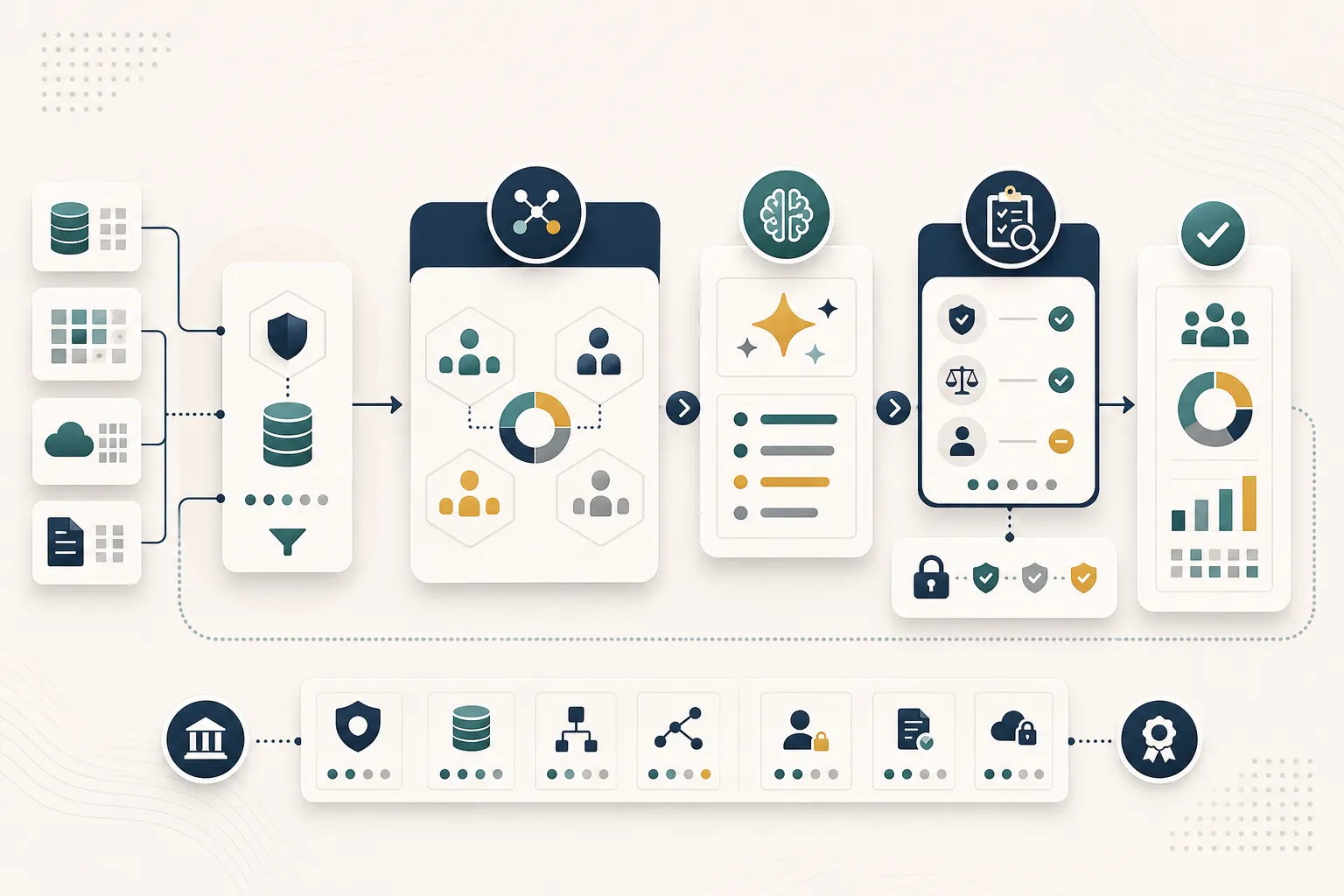
Built a POC on Azure OpenAI and banking-domain data, using Python and Azure Databricks for the data preparation layer. Kept the pipeline small enough to reason about end to end: a controlled prompt layer, a segment-aware context window, and an explicit human-review gate before any generated output left the environment.
The POC demonstrated that personalised messaging is technically feasible in this banking context, but it also surfaced the governance and review work a production version would need: prompt-version control, audit logging of inputs and outputs, segment-level guardrails, and a fallback to templated messaging when model confidence is low.
Framed as a feasibility POC, not a scaled production transformation. The value of the engagement was a clear, review-ready view of what AI in this context can and cannot responsibly do today.
POC design and delivery, scope decisions, and honest scoping of the gap between feasibility and production readiness
Tools: Azure OpenAI, Python, Azure Databricks
Feasibility POCs in regulated environments are worth more when they come back with an honest map of the gap, not a polished demo. The goal here was to test whether a segment-aware prompt could produce usable draft messaging, and to surface the production-readiness cost before anyone committed to scale.
The POC deliverable included, in writing, what would be required before anything shipped: prompt-version control, audit logging of every input and output, segment-level guardrails, and a fallback to templated messaging whenever the model returned low-confidence output. Naming those requirements explicitly is the point of a feasibility POC.
Start with the current constraint, what needs to change, and where delivery risk is showing up now.