Skip to content

Projects

Technical repositories that show how the work gets built.

Semantic model validation, structured PBIP/PBIR engineering, agent harness patterns, and public-good decision workflows each isolate a specific discipline so the approach is visible independent of any single client engagement.

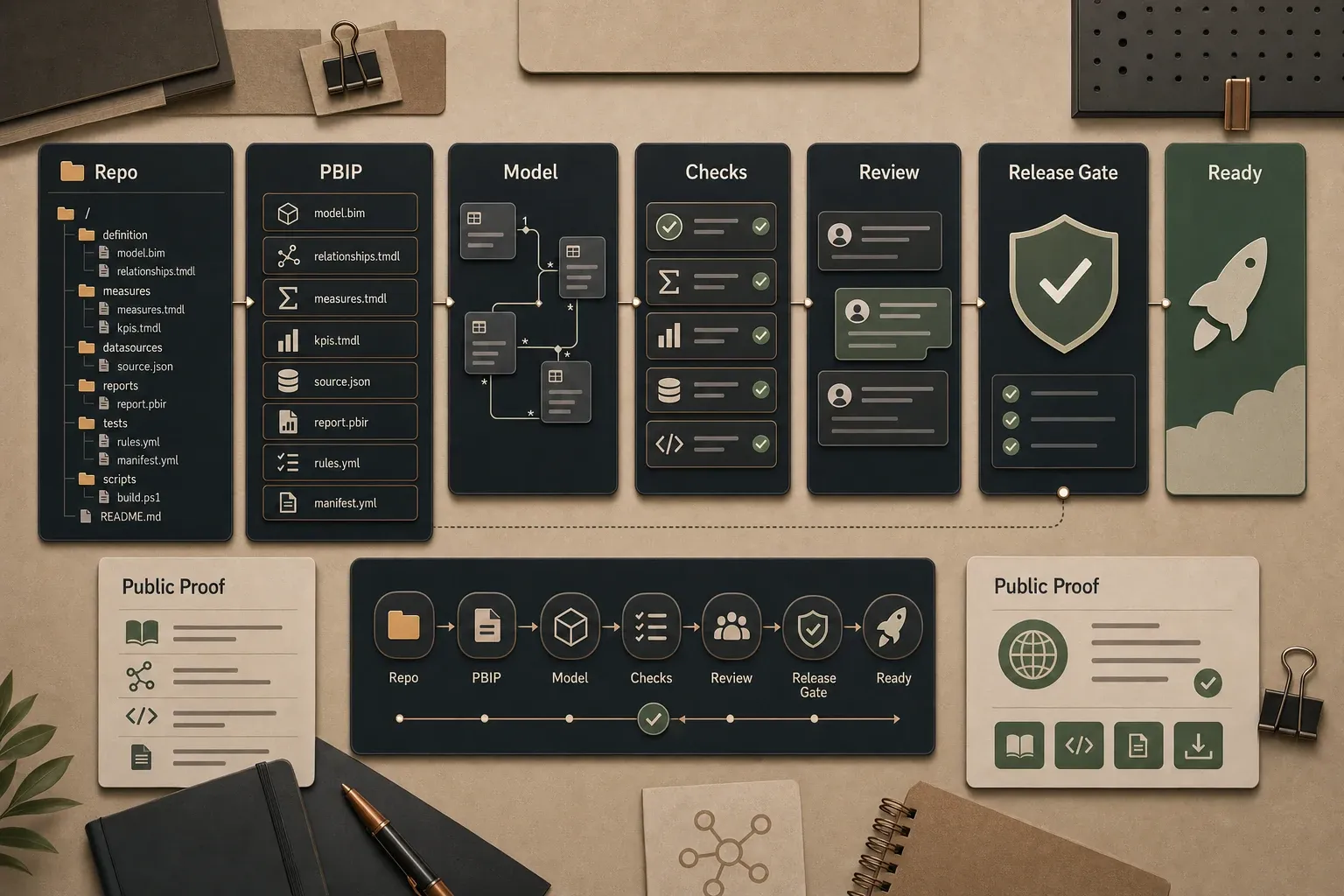
BI engineering workflow diagram connecting public repositories, validation gates, semantic model blocks, and dashboard delivery.

Power BI Reference

Decision-first BI demos built from public data.

These static reference pages show the decision framing, public source gate, model plan, validation notes, and publish-readiness path before any Power BI iframe is allowed.

Static reference

Airline Operational Reliability Decision Review

A public-data Power BI reference demo scaffold showing how airline reliability data can move from decision context to source-aware actions, with semantic model proof and validation gates visible before any iframe is published.

Repository Gallery

Public and inspectable proof first.

Open repositories stay visible first so technical proof is immediately inspectable, including recent applied-AI builder work from OpenAI-related events.

Conceptual Power BI measure-testing scoreboard with pass, fail, warning, and validation workflow panels.
Featured

Automated Measure Testing for Power BI

powerbi_demo_PBIPxGHCopilot

Automated DAX measure testing built on PBIP, Python, and AI-assisted tooling, designed to catch calculation risk before deployment.

Validation-first BI engineering: systematic DAX risk detection, repeatable test coverage, and CI-ready semantic model workflows.

PBIP Python TMDL
OpenSkillTrace team at the Sea x OpenAI Regional Codex Hackathon in Singapore.
Event build

OpenSkillTrace AgentOps Harness

modellismz/OpenSkillTrace

Sea x OpenAI Codex Hackathon build: an AgentOps harness for tracing agent runs, routing fallbacks, checking eval and policy signals, and keeping approval and audit controls visible.

Forward-deployed AI is not just prompt output. The useful work is the control layer around tools, data, fallbacks, and human decision gates.

Codex FastAPI MCP
Group photo at the Asia Pacific Disaster Management AI Skills Jam in Bangkok.
Applied AI field prototype

Dashboard Copilot for Disaster Response

disaster-dashboard-webapp-repo

Disaster-response dashboard copilot shaped around the Asia Pacific AI Skills Jam: profile fragmented CSV and Excel files, surface evidence gaps, recommend dashboard views, and export a reviewable decision handoff.

Applied AI with BI discipline: start from messy operational data, keep deterministic checks visible, use AI only where it improves reasoning, and leave decision ownership with humans.

OpenAI DataKind Decision support

All public repositories focus on reusable methods and engineering patterns. Client-specific implementations remain private; what you see here reflects the discipline applied across every engagement.

Internal Patterns

Selected private or internal patterns.

These stay visible as evidence of working methods, but not as the first proof block.

PBIP and PBIR engineering template board with folder structure and validation checkpoints.
Reusable
Private

PBIP/PBIR Engineering Template

PBI_Agent

A deterministic PBIP and PBIR engineering template that enforces validation gates, consistent folder structure, and governance-ready defaults.

Structured engineering habits that transfer across projects: repeatable repository design, clear validation checkpoints, and governance-aware BI delivery.

PBIP PBIR Validation
Private repository
Multi-agent BI workflow diagram connecting BI, data, and review agents.
Experimental
Private

Multi-Agent BI Workflow Framework

A2A

A multi-agent framework exploring AI-assisted orchestration across Azure, Power BI, and Databricks BI workflows.

Early-stage but grounded: tests whether multi-agent patterns can reduce manual coordination in real BI delivery pipelines.

Azure Power BI Databricks
Private repository

Contact

Interested in applying these patterns to your environment?

These repositories show the engineering approach. If you need that same rigour applied to BI delivery, semantic model validation, agentic workflow guardrails, or operational decision support, let's talk.