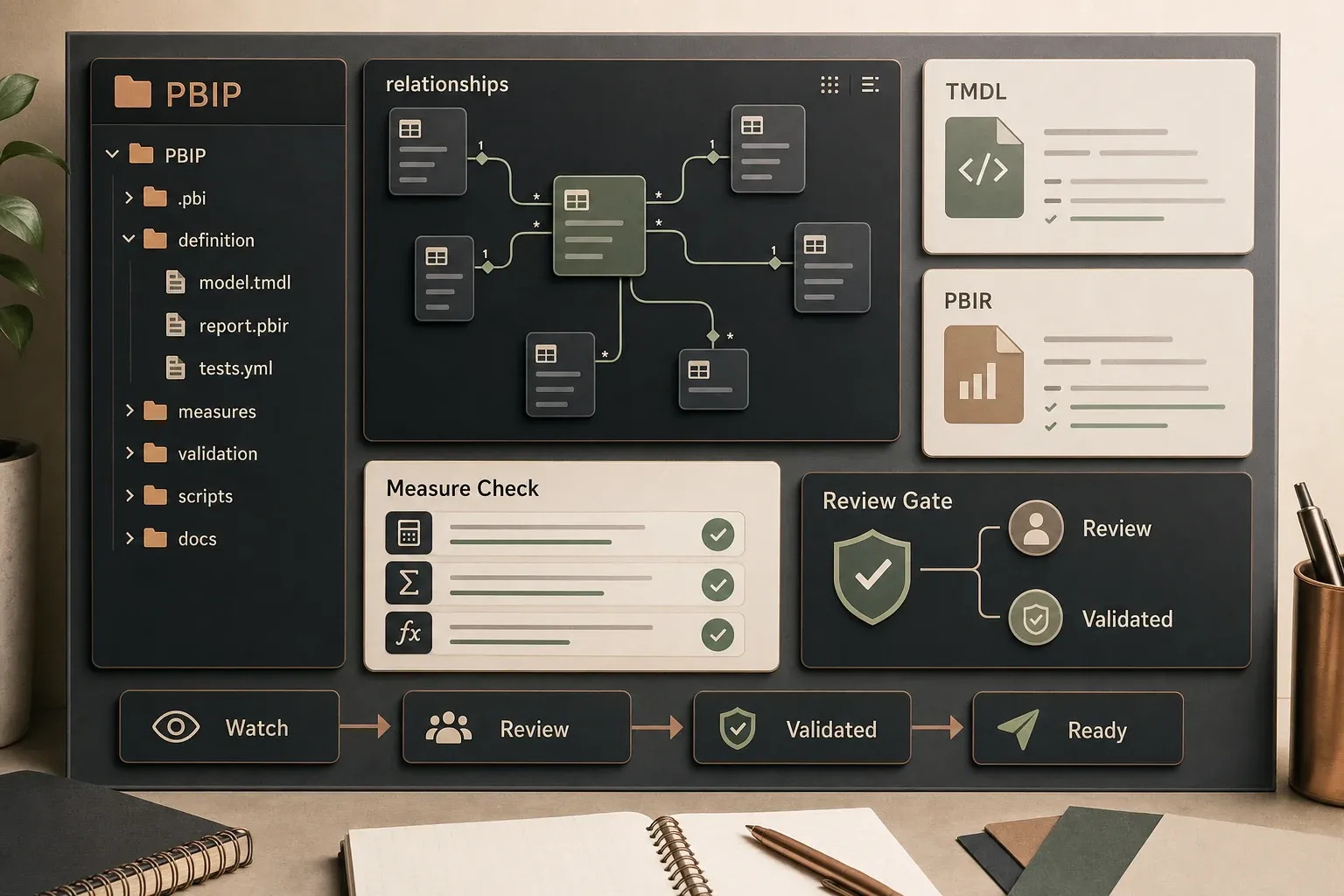
A reusable workflow that turns semantic-model changes into reviewable code: every change produces a diff a reviewer can read, every risky DAX pattern raises an explicit flag, and the deployment path is explicit about what is being promoted and why. Running on 10+ datasets and public for inspection.
BI Engineering
semantic-model
validation
pbip
testing
Portfolio-safe validation workflow frame
Evidence snapshot
Outcome signal
Public repo + Mar 2026 talk
Reusable TMDL/PBIR inspection and DAX risk detection workflow for ongoing production maintenance
Focus
Production maintenance validation workflow
Industry: BI Engineering
My role
Sole designer and maintainer of the validation workflow
Tools: PBIP, TMDL, PBIR, Python
Summary
A reusable workflow that turns semantic-model changes into reviewable code: every change produces a diff a reviewer can read, every risky DAX pattern raises an explicit flag, and the deployment path is explicit about what is being promoted and why. Running on 10+ datasets and public for inspection.
What needed to change
Maintaining 10+ production Power BI datasets and reports alone made measure-level regressions easy to miss. Changes were reviewed manually, if at all, and confidence in deployment dropped as the models grew. The underlying issue: a `.pbix` opened and saved is a review black box — nothing compares the model before and after.
Context and constraints
Industry context: BI Engineering. Primary focus: Semantic Model Engineering. The scope and sequencing were shaped by concrete delivery constraints.
Solo maintenance of 10+ production datasets and reports without a structured validation step
How the work was handled
Moved the dataset and report assets to PBIP format so TMDL (model) and PBIR (report) are plain-text files Git can track. Added a Python inspection layer that surfaces structural diffs and runs pattern-based risk checks against DAX before deployment. AI-assisted drafting generates candidate test scenarios; review gates keep anything automated from auto-approving itself into production.
What changed in practice
A reusable workflow that turns semantic-model changes into reviewable code: every change produces a diff a reviewer can read, every risky DAX pattern raises an explicit flag, and the deployment path is explicit about what is being promoted and why. Running on 10+ datasets and public for inspection.
Built the workflow to support solo maintenance of 10+ production datasets and reports.
Implemented TMDL and PBIR inspection for semantic model structure checks.
Added DAX risk detection before deployment.
Generated draft validation scenarios while preserving review control.
Shows a recent workflow built from real production-maintenance needs — PBIP + TMDL + PBIR as the foundation for treating Power BI like production code — with public proof through a GitHub repo and a Mar 2026 speaking session.
My role
Sole designer and maintainer of the validation workflow
The Python inspection layer parses TMDL and PBIR files and runs pattern-based risk checks against DAX changes. A simplified risk rule looks like this:
defcheck_measure(expression:str, model: Model)->list[RiskFlag]:
flags =[]if uses_related_without_userelationship(expression):
flags.append(RiskFlag(
level="warn",
message="Measure relies on the active relationship; ""pin with USERELATIONSHIP or document the assumption.",))if references_calculated_column(expression, model):
flags.append(RiskFlag(
level="info",
message="Calculated column dependency — confirm refresh cost.",))return flags
AI-assisted drafting produces candidate test scenarios — YoY boundary dates, blank-slicer combinations, measure-interaction edge cases. A reviewer approves, edits, or rejects each one. The AI never deploys.
Why PBIP matters here
Without PBIP, reviewing a Power BI change means opening two files in Desktop and squinting. With PBIP, the change is text; diffs, linting, and automated checks become possible without leaving Git. The workflow above is downstream of that one format decision.
Highlights
Built from the need to maintain 10+ production datasets and reports with stronger validation.
TMDL / PBIR inspection turns Power BI changes into reviewable diffs, not screenshots.
Pattern-based DAX risk detection catches known-bad constructs before deploy.
AI-assisted scenario drafting preserves the human review step — useful, not autonomous.
Public repo and Mar 2026 speaker session for peer inspection.
Need similar help with reporting, model quality, or BI delivery?
Start with the current constraint, what needs to change, and where delivery risk is showing up now.
A new CTRM platform needed specialist Power BI reporting for middle-office, compliance, finance, and trading users, with reliable data flows and near-real-time visibility across multiple report types.
A retail analytics platform needed a more maintainable reporting-layer design and better performance under concurrent usage as analytics adoption expanded.