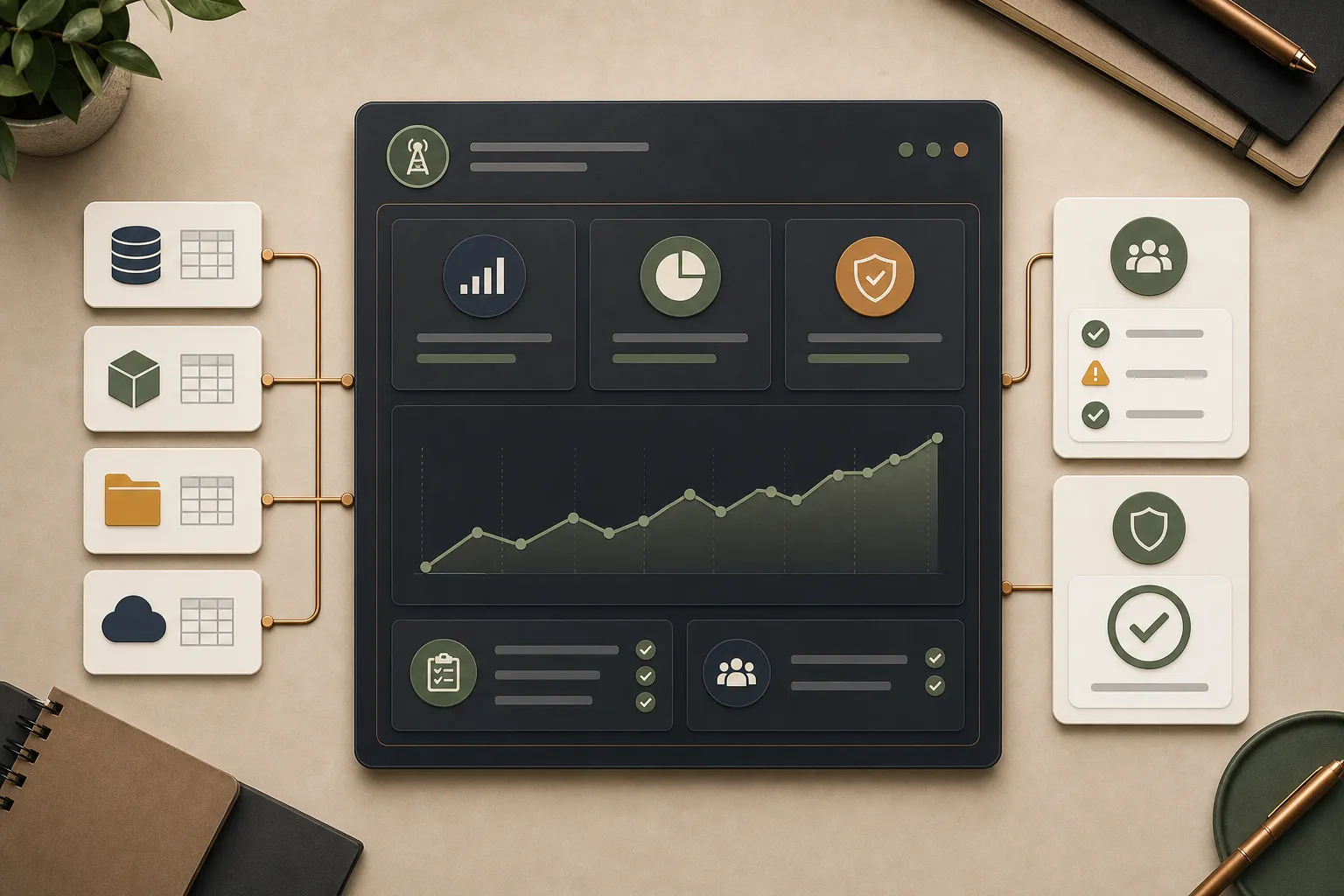
The project produced a stakeholder-validated proof of concept that combined a unified KPI dashboard, AI-assisted anomaly visibility, and user and technical documentation for further evaluation.
Energy
ai-assisted
executive-dashboard
poc
anomaly-detection
Anonymized control tower dashboard frame
Evidence snapshot
Data domains
Finance, operations, investment
Unified into one executive-facing reporting experience.
Delivery assets
Dashboard + user guide + technical spec
The proof of concept shipped with both working screens and handover documentation.
Outcome signal
Stakeholder-validated POC
Validation workshops helped refine metrics, layout, and next-step feasibility.
Summary
The project produced a stakeholder-validated proof of concept that combined a unified KPI dashboard, AI-assisted anomaly visibility, and user and technical documentation for further evaluation.
What needed to change
Leadership teams needed a single view of financial and operational KPIs, along with anomaly and insight visibility in one place.
Context and constraints
The work sat inside a broader digital-transformation initiative and had to make AI-assisted monitoring understandable for non-technical executives.
Multiple business-unit data streams had to be unified into one clear executive view.
The proof of concept needed to demonstrate AI-assisted monitoring without overstating production maturity.
How the work was handled
Co-developed a Power BI control tower proof of concept that unified KPI monitoring with an AI-assisted watchtower layer, while also supporting dashboard layout decisions, validation workshops, and documentation for handover.
What changed in practice
The project produced a stakeholder-validated proof of concept that combined a unified KPI dashboard, AI-assisted anomaly visibility, and user and technical documentation for further evaluation.
Unified financial, operational, and investment KPIs into one executive-facing Power BI POC.
Integrated AI-assisted anomaly signals and near-real-time monitoring concepts.
Supported validation workshops plus user-guide and technical-specification handover materials.
Shows AI-assisted BI delivered as a documented, stakeholder-validated proof of concept rather than hype.
My role
Visualization development, stakeholder validation, and POC documentation
Tools: Power BI, AI/ML Models, PowerPoint, Word
Choices and lessons
Used Power BI to combine KPI tracking, alerts, and management-facing navigation in one view.
Worked across finance, operations, and investment data inputs to create a unified executive layer.
Positioned the work as a disciplined POC with documentation and next-step evaluation, not a production overclaim.
Implementation detail
Highlights
Contributed to a control tower dashboard with AI-assisted monitoring concepts.
Supported a unified reporting view across finance, operations, and investment KPI streams.
Contributed to validation workshops plus user and technical documentation for the POC.
Need similar help with reporting, model quality, or BI delivery?
Start with the current constraint, what needs to change, and where delivery risk is showing up now.
Debt collection messaging was largely template-driven, which limited how well it could adapt to borrower context across segments. Any AI-assisted approach had to work inside banking governance constraints — limited data movement, strict auditability, and no assumption that model output reaches a customer without human review.
Maintaining 10+ production Power BI datasets and reports alone made measure-level regressions easy to miss. Changes were reviewed manually, if at all, and confidence in deployment dropped as the models grew. The underlying issue: a `.pbix` opened and saved is a review black box — nothing compares the model before and after.